Learn more about our mission to promote responsible, sustainable cultivation techniques and positive social reforms that are at the very foundation of everything we do here at 151 Farms.
At 151 Farms we believe
We Really Can Change the World, One Garden at a Time!
1. VIDEOS
Here you’ll find our document videos, the majority we’ve created, that go to promoting logical pathways to responsible legislation and regulation that creates an environment in which we can all grow and prosper. The way we see it we’re ALL connected to each by the food we must eat. Therefore it’s imperative we find ways to work within the natural resources we have available to us, to create sustainable and environmentally responsible ways to care for ourselves and each other. We hope you find our video of interest and will learn that change must come from within. That starts now with you!
2012/08/22: TED TALK: Pam Warhurst “How can we eat our landscapes.”
2016/10/28: Lieutenant Governor Gavin Newsom and Jason Skinner Discuss the Benefits of AUMA/Prop 64
2017/05/11: Dave Armstrong The Difference Between Collectives and Cooperatives
2017/12/17: Dave Armstrong Testifying at SBOE Regarding State and Federal Cannabis Law Conflicts
2021/02/04: Black Side of Liberty with Nickolas Wildstar and Darryl Cotton
2021/01/14: Cannabis Talk 101 Interviews Darryl Cotton
2021/04/08: Libertarian Candidate for CA Gov Nickolas Wildstar and Darryl Cotton
2021/04/28: An Introduction to our 151 Rock Tub Farms by Darryl Cotton
2021/05/01: Eddy and Sandra Lepp of the 151 Farms OG TOUR with Matthew Hutchins
2021/05/03: Matthew Hutchings on the 151 Farms OG TOUR Interview
2021/05/07: Germany, Patrick Ambassador @ 151 Farms Touring the Rock Farms
2021/05/23: Alastair “Running Bear” Mulholland describes the benefits of Rock Farming
2021/06/13: Wildstar Podcast with Activists Heidi Grossman and George Boyadjian
2021/06/15: Wildstar Podcast with Activist Sandra Lepp re Corruption in CA Medical Cannabis Laws
2021/06/17: Wildstar Podcast with Darryl Cotton and Activist Wayne Justmann re Repealing Prop 64
2021/06/22: Wildstar Podcast with Darryl Cotton & Adelanto, CA Activist Diana Esmeralda Holte
2021/06/25: Wildstar Podcast with Darryl Cotton and SLO County Activist Krista Koenig
2021/06/28: Wildstar Podcast with Darryl Cotton and Cannabis Activist Charles Lynch
2021/06/29: Wildstar Podcast with Darryl Cotton and Social Equity Cannabis Activist Jamal Hackler
2021/06/30: Wildstar Podcast with Darryl Cotton and Medical Cannabis Activist John Prinz
2021/07/01: Wildstar Podcast with Darryl Cotton and Medical Cannabis Activist “Dank Dave” Armstrong
2021/07/06: Wildstar Podcast with Darryl Cotton and Noted Medical Cannabis Activist John Prinz
2021/07/07: Wildstar Podcast with Darryl Cotton, Dank Dave and James Cotton, Biologist
2021/07/08: Wildstar Podcast with Darryl Cotton, Dank Dave, Steve Z, NJ Weedman and Debbie Madaio
2021/07/14: Wildstar Podcast with co-hosts Cotton, Armstrong and Koenig with Matthew Hutchings
2021/09/01: Wildstar Podcast regarding Prop 64 and Positive Conflict with Federal Law
2021/09/04: Elliot Lewis is NOT a Happy Prop 64 Licensee
2022/08/27: Flowering Cannabis in a 151 Closed Loop Constant Flow Aquaponics System
2025/12/05: Heroes and Patriots Interview with Captain Matthew Hoh and Darryl Cotton My thanks goes out to John Sakowicz and Mary Massey for their outstanding podcast with former Marine Corp. Captain Matthew Hoh who spoke on both national and international civil rights issues and me on how post Prop 64 adult-use cannabis law and regulation has seriously chipped away at our civil rights and what recourse those who have been harmed by that law and regulation have through our judiciary. Matthew got the first segment and I can be heard at 44:40 into the show.
2026/02/04: Heroes and Patriots Press Release
June 6, 2026 Induction of Dr. Therese Cotton-Uphaus into the IVCC Academic Hall of Fame
2026.07.05: Porta-Potty’s: The Big Business of Imported POOP!
2. DOWNLOADS
Here you will find downloads that explain our mission and our techniques. Feel free to use these files to present to others what it is that a 151 Farm can do for our communities.
151 Rock Farming: It’s Like Bringing a River to Your Roots
151 Rock Farms Systems Description and Standard Operating Procedures
151 Hand Up Program: A Daughter Plea
The Art of Urban Farming as an Inalienable Right
Why Growing Food is the Single Most Powerful Thing We Can Do In a Rigged Political System
We Know the Problems Now What are the Solutions?
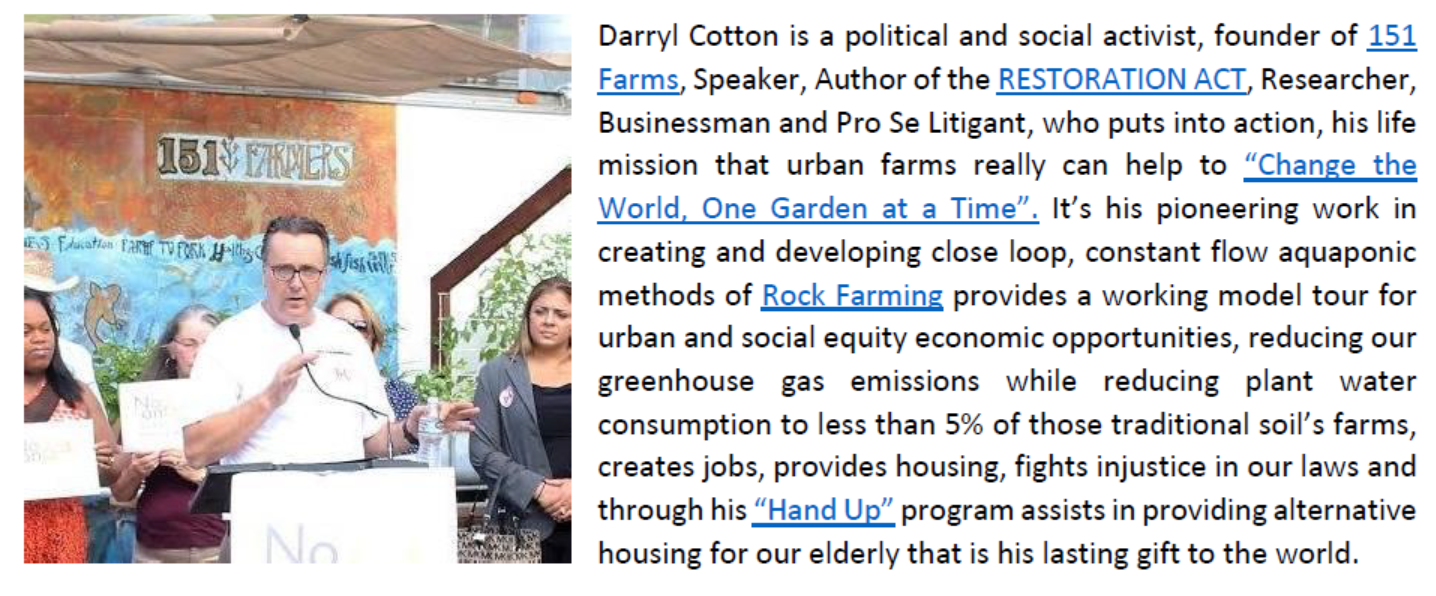
Darryl Cotton Headshot and Bio with Working Links
Darryl Cotton Headshot and Bio Image Without Links
2016/10/28 Gavin Newsom and Jason Skinner AUMA Interview with Time Stamped Notes
2022/06/06 Dr. Carrie Waterman, UC Davis Global Food Alliance
2026/02/05: KMUD Heroes and Patriots Press Release
2026/02/21: Hide the Pea Campaign
151 Letters of Support
3. REGENERATIVE AGRICULTURE
At its core, regenerative agriculture is the process of degraded soils using management practices (e.g., adaptive grazing, no-till planting, no or limited use of pesticides and synthetic fertilizer, etc.,) based ecological principles. Regenerative agriculture strives to work with nature rather than against it. It is more than just being sustainable. It is about reversing degradation and building up the soil to make it healthier than its current state. Regenerative agricultural principles focus on restoring and enhancing soil health by using principles that create more diverse soil microbiological communities. Regenerative farming practices allow food growers to create an ideal subterranean home for soil microbes that, in turn, deliver nutrients to plants, improve soil function (including fertility and water infiltration) and increase the nutrient density of the food they produce—at far less cost than conventional farming practices. Conversely, modern conventional agricultural techniques, which are deeply embedded in the operational farming methods of most agricultural producers today, rely on expensive and often dangerous synthetic inputs that diminish soil health and reduce the nutrient density of our food by focusing on the following elements that help define the regenerative agriculture movement;
Ecosystem Health
- Soil Health Assessment and Regeneration
- Restoration of:
- The Water Cycle
- The Carbon Cycle
- The Nutrient Cycle
- Remediation of Soil Salinity and Sodic Issues
- Growing Biologically Active Soils
- Restoration of Beneficial Insects, Pollinators, Birds, and Wildlife
- Growing and Raising Nutrient Dense Foods
Livestock Husbandry
- Adaptive Grazing Practices
- Beef, Dairy, Small Ruminants, Pastured Poultry, Pastured Pigs
- Grazing Plan Development
- Forage Systems
- Perennial
- Annual
- Grazing Cover Crops
- Farm/Ranch Grazing Designs
- Water Resource Design
- Permanent
- Temporary
- Solar
- High Attribute Forage Finishing
- Multi-Species Integration
- Genetics
- Nutrition
- Reproduction
- Processing, Further Processing, and Packaging
Management of Land, Water and Natural Resources
- Assessment of Ecological Systems
- Microbial
- Insect – Beneficials and Pollinators
- Plant
- Animal
- Wildlife
- Grazing Land Assessment and Systems Design
- Cropland Assessment and Systems Design
- Orchard and Produce Production Assessment
- Water Quality Assessment and Restoration
- Irrigation System Assessment and Design
Growing a Healthy Business
- Enterprise Evaluation and Development
- Enterprise Decision Calculators
- Business and Marketing Plan Development
- Cash Flow Analysis
- Building Brand Awareness
- Multi-Generational Planning
- Quality of Life Planning
- Holistic Financial Planning
2012/05/13: Mohamed Hage, Lufa Farms, “Nothing about Urban Agriculture is Revolutionary”
2024: Understanding AG Promo Video
2024/06/18: Joel Williams, Groundswell Agriculture “The Principles of Regenerative Agriculture”
2024/10/14: TED TALK: GABE BROWN “How Regenerative Agriculture Brings Life Back to the Land”
2024/11/27 Burke Teichert: Understanding AG
2025/05/17: UKKO ROVA BARNS: “Is this the Future of Raising Chicken on Pasture?”
4. PLANT LIGHTING RESOURCES
 151 Farms was developed as a result of our R&D work with artificial plant lighting using a combination of Electodeless Florescent Discharge Lamps (“EFDL”) and Light Emitting Diode (“LED”) technologies that when combined with ideal outdoor photogenic conditions, could mimic those conditions in an indoor environment where additional benefits, such as increased CO2 and photoperiod intensitity levels, could be increased to gain plant response beyond what could be seen in outdoor cycles. Our company, Inda-Gro Lighting, ceased doing business in 2016 as a result of the highly competitive LED market that relied on Chinese manufacturers bringing their products into the US and making it impossible to manufacture an EFDL technology that could compete with the LED price points. However the white papers we produced on plant lighting as well as additional resource papers we will link here are still highly relevant when it comes to understanding the plant to light relationships that must be considered when designing and monitoring the intensities and spectrums that our plants require to achieve the highest quality and yields we strive to achieve in our farms.
INDA-GRO PAPERS
2014.03.12: McCree 1972 Revisited by Hagler and Cotton
2014.06.10: Understanding Plant Light with Technical Comparisons by Hagler and Cotton
2014.08.15: Understanding PPF and PPFD in Measuring Plant Light Intensities by Hagler and Cotton
2015.02.07: Understanding Spectral Distribution Graphs by Hagler and Cotton
Inda-Gro 200 Watt UV Sterilizer
Pentair Private Labels Inda-Gro Grow Lights
ADDITIONAL RESOURCES
June 2014: An Economic Analysis of Supplemental Greenhouse Lighting Systems by Nelson and Bugbee
Understanding Phytochrome Equilibrium by Koning
The Importance of Phytochrome in Plant Growth and Flowering by King and Bagnall
Green Light: Is it Important for Plant Growth? by Wollaeger
All Colors in Light are Equal for Photosynthesis by Stijger
Photosynthesis by Rabinowitch and Govindjee